


History
The Serres breed belongs to the lowland group of even-woolled, thin-tailed sheep. Its stronghold is the Serres valley in northeast Greece where the majority of the remaining pure herds are found. It is an old breed. Early 20th century accounts attribute its origin to crosses of indigenous sheep with the Zigaya breed. Rams of the Serres breed were used as crosses in many herds in the lowlands of east Macedonia and Thrace. Nevertheless, in recent years breeders show a preference for other Greek and foreign breeds such as Karagouniko, Chios, Lacaune and Assaf. In 2000 ‘STRYMON’ the Agricultural Co-operative of Serres Sheep Breeders was established with the breed’s genetic improvement and promotion in mind.
Morphological Traits
Serres Sheep are of a relatively large size. Rams weigh 60-85 kg and ewes 45-65 kg. Average height at the withers for rams and ewes is 76 cm and 67 cm, respectively.

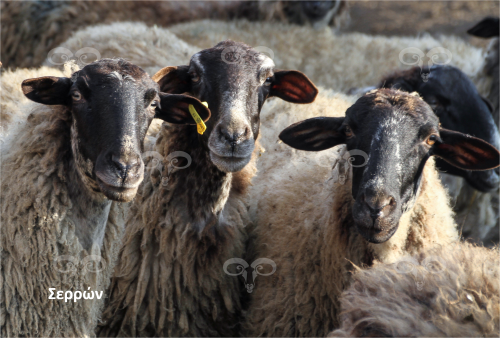
The rams carry large, strong, spiraling horns while 30 % of ewes are horned. The head is long and narrow with a convex profile. It has long, thin ears carried horizontally.The chest is quite deep and relatively narrow. The back is level. The limbs are slender, long and strong. Its tail is relatively long.
The wool is of a yellowish tone. The head, limbs and often the belly are wool free. Serres sheep have a distinct and uniform colour pattern. The majority have yellowish to off-white bodies but solid black in the wool free areas. A small percentage of animals shows different colours.
Population
According to the Thessaloniki CAGR, the ‘Serres Breeders Cooperation’ has registered 4.800 animals in its herd book.
The status of the breed is considered ‘Not at Risk’.