


History
The Sfakia Sheep breed originated on the island of Crete. It is named after the Sfakia region in the Chania prefecture and is bred throughout the western part of the island. It is excellently adapted to the steep and rocky island terrain as well as to mountainous and semi-mountainous conditions. In eastern Crete it is crossed with the Anogia and Sitia breeds which predominate in the prefectures of Heraklion and Lasithi. It is bred under extensive or semi-extensive foraging conditions and utilizes the relatively poor island vegetation. In the summer months plenty of herds translocate to mountain pastures, especially in the White Mountains of Crete. A pure herd was maintained for years at the ‘Asomaton Agricultural Research Station’ in Rethymnon. In recent years a number of Sfakia sheep breeders joined the ‘Co-operative of Sfakia Livestock and Olive Oil Producers’ monitored by the Athens CAGR.
Morphological Traits
The Sfakia are a small sized, coarse-woolled, and thin-tailed mountain type sheep. Average weight for rams is 60 kg and ewes 40 kg. Their respective withers height is 68 cm and 58 cm.
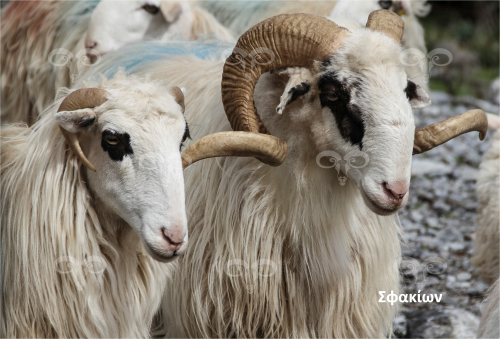

Ewes are normally polled. Rams have strong spiral horns with outward projecting tips. The head is long with a convex profile. Ears are of medium length, carried horizontally. The chest is relatively lacking in depth and narrow, as is the thorax.
The wool contains sparse, uniform, smooth, thin, long hair. The head, limbs and belly are wool free. The colour is normally white with small black, rounded spots encircling the eyes and black spots on the face, ears and limbs. Rarely are they uniformly black.
Population
According to 2019 data from the Athens CAGR, the total population of the breed is approximately 70,000 animals.
The status of the breed is considered ‘Not at Risk’.