


History
The origin of the Kalarrytiko is attributed to textile merchants and livestock keepers from the village of Syrako (Epirus); in the 1700s they crossed sheep of the Vlach breed with south Italian sheep resembling the modern Sicilian Comisana breed, to improve the quality of imported Italian wool. It is named after Kalarrytes, a village in the Tzoumerka Mountains (Epirus). Nowadays, Kalarrytiko herds are kept in extensive farming conditions. In the summer months they are moved to pastures in the Tzoumerka Mountains and spend the winter in the plains or semi-mountainous areas of Thessaly (Tyrnavos, Vlochos, Amfithea) or Aetoloakarnania (Aktion). Formerly the Kalarrytiko was perceived as a type of Vlach sheep but its phenotype shows significant differences. They are a mountain type sheep suitable for meat production. Kalarrytiko sheep have great cultural and emotional significance for their traditional breeders who are determined to preserve the breed and invest in modern installations. It is esteemed for its carcass quality while its milk is utilized in cheese making.
Morphological Traits
Kalarrytiko is a small-sized, coarse-woolled, thin-tailed sheep. Its muscular development is typical of meat type breeds. Weight for rams is 60-68 kg and ewes 43-47 kg. Height at the withers for rams and ewes is 65-69 cm and 58-62 cm respectively.

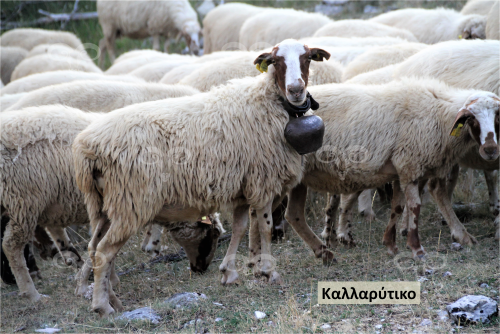
Nearly all rams carry large, strong spiraling horns encircling the ears. Ewes are polled. The head is conical with a slightly convex profile and medium size ears carried horizontally. A distinguishing feature is its wide chest. The chest’s great muscular development, and the long ridge separating its lower part, create an impression of being double the size. The great chest and thorax combined with the animal’s overall construction render Kalarrytiko a superior meat producing breed. The limbs are short and strong.
The wool coat is dense with a high percentage of awn-like hair. The face, belly and limbs are wool free. The colour is uniform. The fleece is white with red-gray markings on the face, eyes, mouth, cheeks and ears.
Population
The total population of the Kalarrytiko breed is approximately 7,800 animals.
The status of the breed is considered ‘Not at Risk’.