History
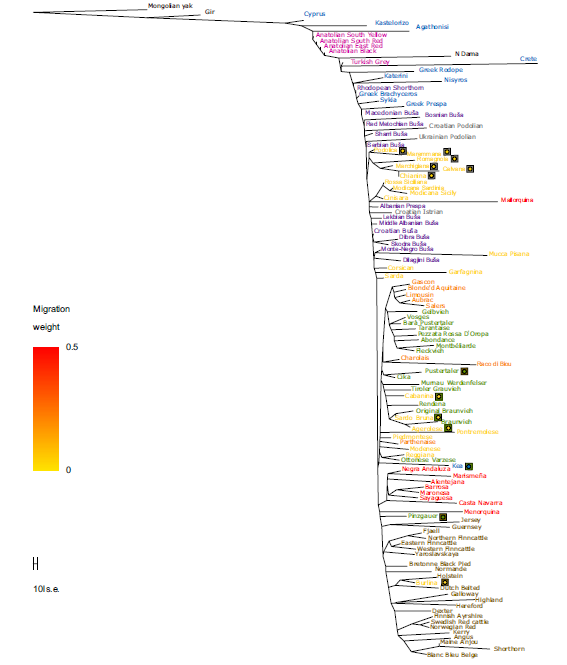
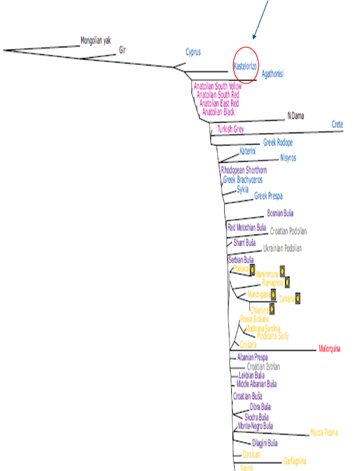
The Kastellorizo cattle are relics of a population formerly bred in Kastellorizo and neighbouring islets. There are no historical records, but the population is reported to be isolated for at least 80 years. There are different speculations about their origin. It is possible that the animal’s ancestors arrived from Astypalea or Kalymnos as many residents of these islands moved to Kastellorizo in the past, along with their livestock and entire households. Another theory is that they are related to populations originated from the Turkish coast nearby (Kas and related district). The recent genetic study focused on all Greek autochthonous cattle (Papachristou et al., 2020) revealed important results about cattle relations and ancestry, with all South-Eastern Aegean, Cypriot breeds/populations being related and showing closer ties to the GIR (i.e. an Indian breed of zebuine cattle), which is the Bos indicus representative and root of the genetic relationship tree (see figure below). Actual number of animals is of 10 at the time the transport to Rhodes in 2024. The animals are divided into two herds. A breeding program has been established, under the supervision of MGO “Amaltheia”.
Characteristics
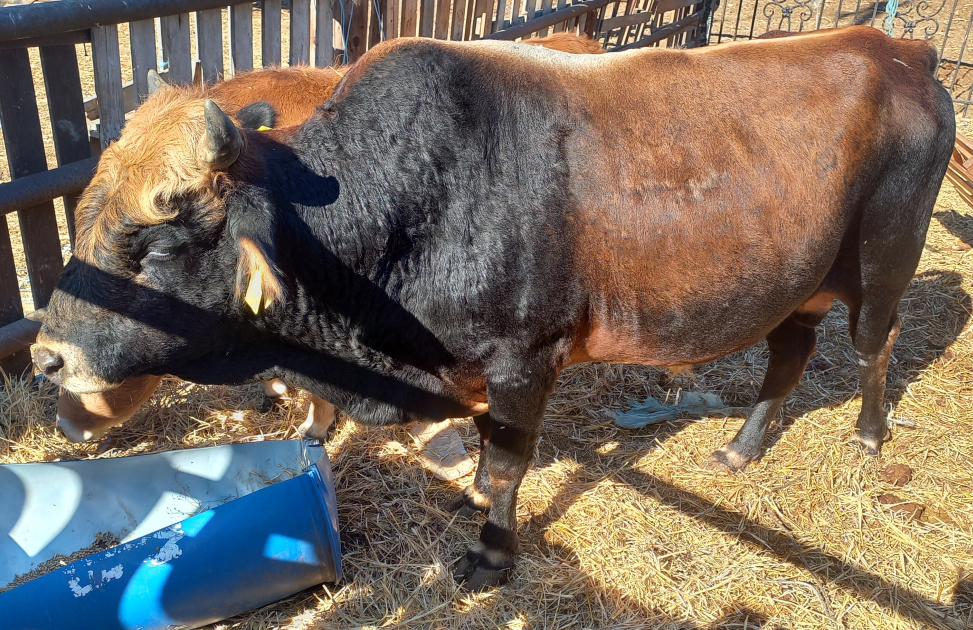
The population has been minimally studied. The animals were used for work and meat, with a little production of milk as well. Cattle live in the open air year round, are hardy, resilient and receive no special care. The coat colour is chestnut brown to dark brown, black or greyish white with black or white rings around the eyes. The muzzle is black with a white ring. The upward horns are short, white with black tips and curved internally. Measurements obtained from a previous study (Achladiotis, 2015), show an average withers height of 112 cm for bulls and 101 cm for cows. Average body length for bulls is 167 cm and 137 cm for cows. Typically bulls have a small hump at the withers, a developed dewlap and dark eye rings. Cows show typically whitish eye rings.
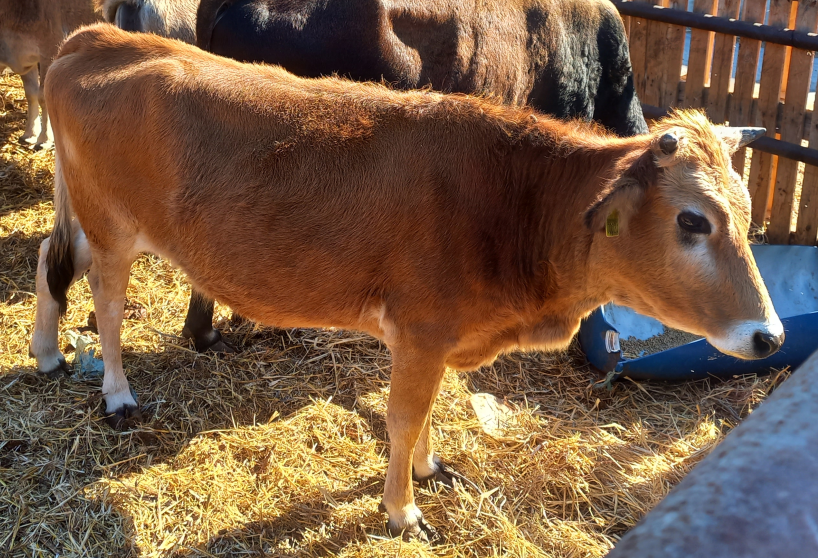
Population and breeding project
Today the population is at an extremely critical state with only 11 animals surviving. It is classified as “Critical”. Therefore it is of highest priority to safeguard this unique cattle population from complete extinction.
In July 2024, a group of breeders and a veterinarian from Rhodes, succeeded to purchase and transport the last cattle of Kastellorizo to Rhodes. This action was privately financed and performed with the support of the State veterinary service in Rhodes. The team is formed by the environmental organisation Open Gaia and the Farma of Rhodes-Petting Zoo. The rescue action has really saved at the last moment the critically endangered cattle population of Kastellorizo island!
Amalthia had tried to re-allocate the animals in the past without success, due to trading difficulties with the original breeder.
Totally, 10 animals were transported including calves and adults. They were divided into two separate breeding nuclei, each having 5 animals (two bulls and 3 cows each). Aim is to increase the number of this rare population and to find more breeders interested in keeping such cattle. Under the supervision of Amalthia, a breeding plan is being implemented by dividing the animals in smaller breeding groups, since there are 4 bulls available.
References
Amalthia book, 2021 Greek Domestic Breeds, a hidden treasure
Papachristou et al, 2020, Genomic diversity and population structure of the indigenous Greek and Cypriot cattle
I. Achladiotis, 2015, ΜΕΛΕΤΗ ΤΟΥ ΠΛΗΘΥΣΜΟΥ ΒΟΟΕΙΔΩΝ ΤΟΥ ΣΥΜΠΛΕΓΜΑΤΟΣ ΝΗΣΩΝ ΜΕΓΙΣΤΗΣ